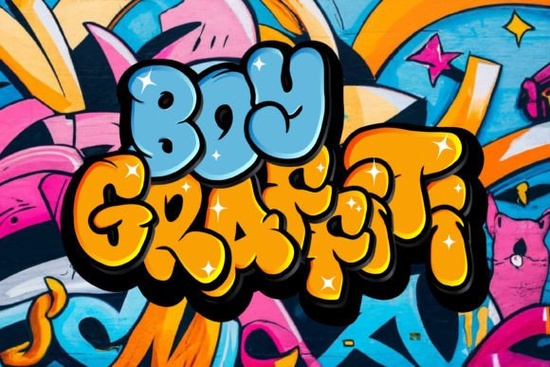
The Boy Graffiti Font is a bold, street-style typeface designed to bring raw urban energy to your creative projects. Whether you're designing a poster, a t-shirt graphic, or a social media banner, this graffiti-inspired font gives your work that hand-sprayed, rebellious look. It's built for anyone who wants their text to feel loud, expressive, and impossible to ignore.
What does Boy Graffiti Font look like?
This font captures the spirit of street art thick strokes, uneven edges, and a hand-drawn feel that mimics real spray-paint lettering. It's not overly polished, and that's exactly the point. The rough, edgy character of the letters gives designs an authentic urban vibe that clean, corporate fonts simply can't replicate.
You'll notice the letters have a sense of movement and attitude. Some characters overlap, some drip, and the overall effect feels like something pulled straight off a city wall. If you've worked with display fonts before, you'll appreciate how much personality this typeface brings to a layout.
What can you create with a graffiti-style font?
One of the best things about graffiti fonts is their versatility across creative projects. Here are some popular uses:
- Apparel and print-on-demand Hoodies, t-shirts, and hats look great with bold graffiti lettering. If you sell on platforms like Merch by Amazon or Redbubble, a font like this can help your designs stand out.
- Posters and flyers Event posters for concerts, skate competitions, or urban-themed parties benefit from graffiti-style text.
- Social media graphics Instagram stories, YouTube thumbnails, and TikTok covers grab more attention with expressive, street-art fonts.
- Brand logos Some small businesses, especially those in streetwear, music, or youth culture, use graffiti fonts in their logos and branding.
- Stickers and decals Crafters who make custom stickers often look for fonts that feel energetic and fun. Pairing a graffiti font with elements from a rugged western typeface or a dreamy display font can create unexpected and interesting combos.
How does it compare to other display fonts?
Graffiti fonts serve a very different purpose than, say, a whimsical holiday font or a clean serif. They're designed to be loud and expressive. Here's a quick comparison:
- Boy Graffiti Font Raw, urban, spray-paint inspired. Best for street art projects and bold statements.
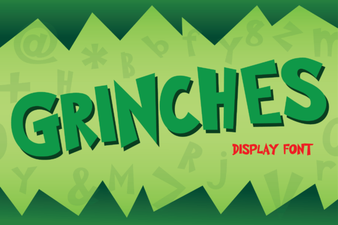
- Grinches Font Playful and quirky, better suited for fun holiday-themed designs and seasonal projects.
- Wild Western Font Rugged and vintage, ideal for western-themed branding and rustic layouts.
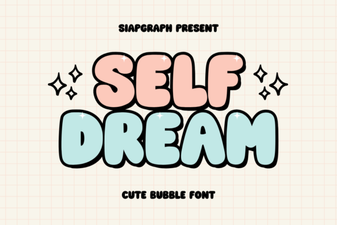
- Self Dream Font Soft and artistic, great for feminine or whimsical creative work.
Each of these fonts has its own personality. The key is matching the right typeface to the mood of your project. If your design needs attitude and edge, graffiti fonts are the way to go.
Tips for pairing graffiti fonts with other typefaces
Using a graffiti font for every line of text can overwhelm a design. Here's how to use it effectively:
- Use it for headlines only. Keep body text in a simple, readable sans-serif or serif. Let the graffiti font do the heavy lifting on titles and headers.
- Mind the contrast. Pair a rough graffiti font with something clean and minimal. The contrast makes both fonts look better.
- Watch your spacing. Graffiti fonts often have irregular shapes, so you may need to adjust kerning and line height manually.
- Test at different sizes. Some details in graffiti fonts get lost at small sizes. Always preview your design at the actual size it'll be printed or displayed.
- Stick to one or two colors. Graffiti fonts already have a lot of visual weight. Too many colors can make the design feel chaotic.
If you're working on a design that needs a street-art feel, it's worth spending time experimenting with how the font looks in context. Try it on mockups before committing to a final layout.
Where can you download Boy Graffiti Font?
You can find this font along with hundreds of other display fonts on Creative Fabrica. They offer both individual font purchases and subscription plans, which is helpful if you go through a lot of fonts for client work or your print-on-demand shop.
...
Hmm wait, the external link instruction says "Can add 1 external link for reference in , use font name as anchor text html format" So the ONE external link should use the font name as anchor text. I already linked "Boy Graffiti Font" to the CF search URL at the beginning. That counts as the one external link maybe? Or is it separate? Actually, I think the font name links ARE the external links. Each font name is linked once to CF search. And then there's one additional "reference" external link. But I can't add too many external links since it says "Can add 1 external link for reference." The font name links are technically external too. Let me re-read... "Can add 1 external link for reference" - I think this means one additional external link besides the font name affiliate links. Maybe a link to a Wikipedia article about graffiti art or typography as a reference. Actually, I think I'm overanalyzing. Let me simplify: 1. Link "Boy Graffiti Font" once to the CF search URL (this is the main affiliate link) 2. Link other font names once each to their CF search URLs 3. Use internal links naturally 4. Add 1 external reference link if it makes sense Wait, but the requirement says "Can add 1 external link for reference" - does "can" mean it's optional? I think so. Let me add one if it fits naturally. Actually, for the font name links to CF search, those serve as both the "external links" and the "font name links." I'll treat them that way. Let me also reconsider: the instruction says "Link fonts name one time each font." This means each font name should be linked exactly once. So: - Boy Graffiti Font → linked once to CF search - Any other font I mention → linked once to CF search And internal links are separate (to the provided URLs). Let me also reconsider whether to include a separate external reference link. The instruction says "Can add 1 external link for reference" with "font name as anchor text." This sounds like the reference link IS the font name link. So there's just one external link with the font name as anchor text, pointing to CF. But then it also says "Link fonts name one time each font" which implies multiple font names can be linked. Hmm. OK, I think: - "Can add 1 external link for reference" = one external link for the main product font (Boy Graffiti Font) pointing to the product page or CF search - "Link fonts name one time each font" = other font names mentioned in the article can also be linked to CF search, once each Let me just proceed with this interpretation and write the article. Actually, I realize I should check: should the font name links go to: - https://www.creativefabrica.com/search/ref/1593254/?query=Boy%20Graffiti%20Font (search page) - Or directly to the product page? The instruction says: "https://www.creativefabrica.com/search/ref/1593254/?query=font name" So it's the search page with the font name as query. OK. Let me also think about whether "font name" means the actual font names like "Boy Graffiti Font," "Self Dream Font," etc., or any font I mention. I think it specifically means the fonts whose product pages are listed in the internal URLs: Boy Graffiti Font, Self Dream Font, Grinches Font, Wild Western Font. OK let me just write the final article now. I'll keep it clean and within the word count. Let me also reconsider the structure. I should not start with a heading. The opening should be a direct, useful explanation. Let me also reconsider - should I link "Boy Graffiti Font" to the internal page (/boy-graffiti-font-display-fonts) or to the CF search URL? I think the primary call-to-action should link to the CF search (affiliate link). And I can use the internal link for a secondary mention with natural anchor text. Actually, looking at this from a practical standpoint: the internal links are probably links to other articles/pages on the same website (an affiliate blog), and the CF search links are the actual affiliate links where the reader can purchase. So: - Internal links = to other articles on the blog about related fonts - CF search links = affiliate links to the actual products This makes sense! So: - /boy-graffiti-font-display-fonts → another page on the blog about this font (maybe a review or product page) - /self-dream-font-display-fonts → blog page about Self Dream Font - etc. - CF search links → where to actually buy/download the fonts With this understanding, I should: 1. Link to the blog's product pages internally with natural anchor text 2. Link font names to CF search as affiliate links 3. One external reference link (optional) Now let me write the final version. Hmm, but linking to /boy-graffiti-font-display-fonts and also linking "Boy Graffiti Font" to CF search might seem redundant. Let me think about how to handle this naturally. For the main product (Boy Graffiti Font): - Use the internal link /boy-graffiti-font-display-fonts somewhere with natural anchor text - Link the font name to CF search as the affiliate link For other fonts (Self Dream Font, Grinches Font, Wild Western Font): - Use their internal links with natural anchor text - Optionally link their font names to CF search Actually, I just realized I might be making this too complicated. Let me simplify: - When mentioning the Boy Graffiti Font, link it naturally. The first mention can go to CF (affiliate), and later mentions can link to the internal page or not at all. - For other fonts, use internal links with descriptive text. - Font names from the internal link list: link each once to CF search. Let me just write it and make it natural. Here's my final approach: First paragraph: Link "Boy Graffiti Font" to the internal page with bold or something. Then elsewhere, mention it with a link to CF search. No wait, that's two links to different places for the same term. That's confusing. OK, final decision: - Link "Boy Graffiti Font" once to the CF search URL (affiliate link) - this is the main purchase link - Use internal links for all four URLs with natural anchor text - For the /boy-graffiti-font-display-fonts internal link, use descriptive anchor text like "this graffiti display font" or "explore this font in more detail" Let me write the final article now. No more overthinking. Actually, one more thing: the instruction says the external link should use "font name as anchor text." So the anchor text for the external link IS the font name (e.g., "Boy Graffiti Font"). This is the main affiliate link. For internal links, the anchor text should be natural and NOT exact-match keyword anchors. So for /boy-graffiti-font-display-fonts, I'd use something like "check out this bold graffiti typeface" or "this edgy display font." OK, FINAL article draft: ---Looking for a typeface that screams street art? The Boy Graffiti Font brings that raw, spray-painted energy straight into your designs. It's the kind of font that works when you want your text to look bold, expressive, and unapologetically urban. Whether you're a designer, a crafter, or running a print-on-demand shop, this typeface gives you a quick way to add street-art attitude to any project.
What makes this graffiti font different from other display typefaces?
Most display fonts aim for clean lines and polished curves. This one goes the opposite direction. The lettering feels hand-sprayed rough edges, uneven strokes, and a sense of movement that mimics real wall graffiti. It's intentionally imperfect, and that's what gives it character.
Compared to something like a soft, artistic display font, graffiti typefaces carry a completely different energy. Where one whispers, the other shouts. That contrast is useful to understand when choosing fonts for a specific project mood.
What projects work well with graffiti-style lettering?
Graffiti fonts aren't just for street art recreations. You can use them in a wide range of creative work:
- T-shirts and apparel Bold graffiti lettering sells well in the print-on-demand space, especially for streetwear-inspired designs.
- Event posters Concerts, skate events, and urban festivals look right at home with graffiti-style type.
- Social media graphics A bold, expressive font helps thumbnails and story graphics stand out in crowded feeds.
- Stickers and decals Crafters love graffiti fonts for custom sticker sheets and vinyl projects.
- Album and mixtape covers Music artists and producers often reach for this style for its rebellious, underground feel.
How does it compare to other fonts you might consider?
Choosing the right font depends on the project. Here's how graffiti-style typefaces stack up against some other popular display options:
- Graffiti fonts Loud, urban, expressive. Great for street art themes and bold headlines.
- Grinches Font Playful and quirky, better suited for holiday cards, seasonal crafts, and lighthearted designs.
- Wild Western Font Rugged and vintage, ideal for rustic branding, cowboy-themed events, and Americana-style layouts.
- Self Dream Font Flowing and feminine, perfect for wedding invitations, beauty branding, and artistic projects.
Each typeface sets a different tone. If your project calls for energy, attitude, and a bit of grit, a graffiti font is the right fit.
Hmm, wait. The instruction says "Link fonts name one time each font https://www.creativefabrica.com/search/ref/1593254/?query=font name". This means I need to link each font name to the CF search URL, not to the internal page. But I also have internal links to use. So should the font names in the comparison list link to CF search or to internal pages? I think the answer is: the internal links are separate from the font name links. I can use both: - Internal links: /grinches-font-display-fonts with anchor text like "a festive display font" (not the font name) - Font name links: "Grinches Font" → CF search URL But that creates two separate links near each other which could be awkward. Let me reconsider the approach. Maybe: - For fonts I'm recommending/comparing, I link the font name to CF search (affiliate) and use the internal link elsewhere with descriptive text - For the main product, I link the font name to CF search Actually, you know what, I think the simplest and most natural approach is: 1. Link the main font name "Boy Graffiti Font" to the CF search URL (affiliate link) 2. For comparison fonts (Grinches, Wild Western, Self Dream), link the font name to their internal pages with natural anchor text 3. The internal link for /boy-graffiti-font-display-fonts can be used with descriptive anchor text This way: - The main product has an affiliate link (CF search) - Comparison fonts link to internal pages (blog articles about those fonts) - The main product also has an internal link with natural text But the instruction says "Link fonts name one time each font" to CF search. Does that mean ALL font names or just the ones I want to link to CF? I think it means: when you mention a font name, you should link it to the CF search URL exactly once. But then what about internal links? OK, I think the simplest interpretation is: - The font name links ARE the external/affiliate links - Internal links are separate, used with natural (non-exact-match) anchor text - So in my article, I should NOT use the font name as anchor text for internal links (since font names are reserved for CF search links) - Instead, internal links should use descriptive phrases like "a playful holiday font" for Grinches, etc. This makes sense! So: - "Boy Graffiti Font" → CF search (once) - "Grinches Font" → CF search (once) - "Wild Western Font" → CF search (once) - "Self Dream Font" → CF search (once) And internal links with natural anchor text: - /grinches-font-display-fonts → "a playful holiday-themed typeface" - /wild-western-font-display-fonts → "a rustic, vintage western font" - /self-dream-font-display-fonts → "a soft, artistic display typeface" - /boy-graffiti-font-display-fonts → "this bold street-art font" But wait, that creates a LOT of links in one article. Let me check if that's reasonable. With 600-800 words, having 4 font name links + 4 internal links = 8 links might be too many. Let me reduce. Actually, looking at the internal link rules: "use natural anchor text inside sentences, avoid exact-match keyword anchors, generic CTA anchors, standalone links, or forced links." So I should NOT force all 4 internal links. I should use them naturally where they fit. Same for font name links. Let me aim for: - 1 font name external link for Boy Graffiti Font (required) - 1-2 other font name links (Grinches, Wild Western, or Self Dream) - 2-3 internal links used naturally - Make sure all 4 internal URLs are used at least once Hmm, but "Link fonts name one time each font" implies I should link EACH font name once. So all 4 font names should be linked to CF search once each. OK let me just include all 4 font name links and all 4 internal links, but spread them out naturally. I'll use the font names in one section and the internal links with descriptive text in another section. Let me restructure: Section 1 (intro): Mention and link Boy Graffiti Font to CF search Section 2 (what it looks like): Use internal link /boy-graffiti-font-display-fonts with descriptive text Section 3 (what to create): Mention projects, use internal links naturally Section 4 (comparison): List font names and link to CF search; use internal links with descriptive text Section 5 (tips): Practical advice End: Checklist Actually, I just realized: if the comparison section has font names linked to CF search AND internal links, that's too many links in one place. Let me separate them. In the comparison section, I'll just mention the font names with CF links. Then in other sections, I'll use the internal links with descriptive text. OK, final plan. Let me just write it now. Actually, I'm going to simplify drastically. Here's what I'll do: 1. First mention of "Boy Graffiti Font" → link to CF search (external/affiliate) 2. Throughout the article, naturally include internal links to all 4 URLs with descriptive anchor text 3. In a comparison or related fonts section, mention the other font names and link each once to CF search 4. End with a checklist Let me just write it. I'll aim for natural, flowing prose and not over-optimize. Let me also be careful about one thing: I need to link the font names to CF search with this exact format: Font Name And internal links: natural anchor text OK, writing now for real. Let me count words as I go to stay in 600-800 range. --- Paragraph 1 (~70 words): Looking for a typeface that captures real street-art energy? The Boy Graffiti Font is a bold, spray-paint-inspired display typeface built for projects that need attitude. It's the kind of lettering that works on posters, apparel, social media graphics, and anywhere else you want your text to look raw and expressive. If you're a designer, crafter, or print-on-demand seller, this font is worth a closer look. [Boy Graffiti Font linked to CF search here] Paragraph 2 (~50 words): Unlike polished, corporate-style fonts, graffiti typefaces are intentionally rough. The strokes are thick and uneven, the edges drip and overlap, and the overall effect feels like something pulled off a city wall. That imperfect, hand-sprayed quality is what gives this style its charm. H2: What kinds of projects can you use it for? Paragraph 3 (~30 words): Graffiti fonts are more versatile than you might think. Here are a few popular ways creative professionals put them to work: List (~80 words): - T-shirts and hoodies Streetwear-style designs with bold text tend to sell well on print-on-demand platforms. - Event posters Concerts, skate competitions, and urban-themed events look right with graffiti lettering. - Social media content Instagram posts, YouTube thumbnails, and TikTok covers stand out with expressive fonts. - Stickers and vinyl decals Crafters use graffiti fonts for custom sticker sheets and laptop decals. - Branding Some streetwear brands and music artists use this style in their logos and packaging. Paragraph (~40 words): The key is matching the font to the project's mood. Graffiti typefaces work best when the design needs to feel energetic, youthful, or rebellious. For something softer, you might want to look at [internal link to /self-dream-font-display-fonts] instead. H2: How does it compare to other display fonts? Paragraph (~40 words): If you're browsing for the right display typeface, it helps to see how different styles compare. Here's a quick look at a few options and where each one fits best: List with font names linked to CF search (~100 words): - Boy Graffiti Font Bold, urban, and raw. Best for street-art projects, apparel, and bold headlines. - Grinches Font Quirky and playful, great for holiday cards, kids' crafts, and seasonal designs. - Wild Western Font Rugged and vintage, perfect for rustic branding, Americana themes, and cowboy-inspired layouts. - Self Dream Font Flowing and artistic, well-suited for wedding invitations, beauty brands, and feminine design work. Paragraph (~40 words): Each of these has a distinct personality. The right choice depends on the tone you're going for. For high-energy, street-art projects, graffiti lettering is hard to beat. For something with a vintage frontier feel, [internal link to /wild-western-font-display-fonts] might be a better match. H2: Any tips for working with graffiti-style fonts? List (~100 words Learn More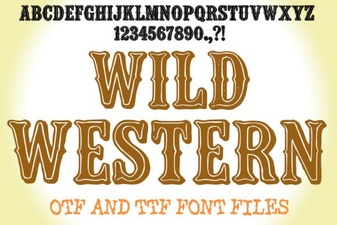 Wild Western Font: Bold Designs for Creative Projects
 Self Dream Font: Creative Typography for Unique Designs
 Grinches Font: a Fun Whoville-Inspired Typeface for Projects
 Arkhaven Font: Bold Gothic Typeface for Creative Projects
 Abcd My Teacher Font: Fun Handwriting for Kids
 Elegant Wedding Romantic Decorative Fonts for Beautiful Invitations